LIFTING BEAM FOR STRAW BALES AND BIOMASS FUEL HANDLING SYSTEMSApril 7, 2026
LIFTING BEAM FOR STRAW BALES AND BIOMASS FUEL HANDLING SYSTEMS
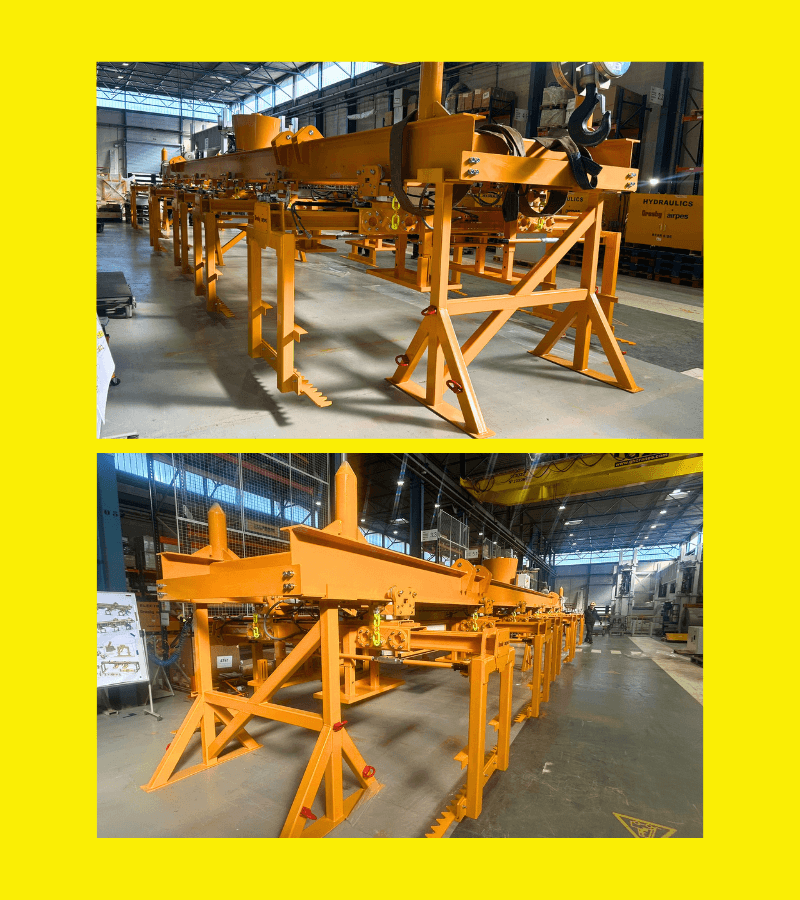
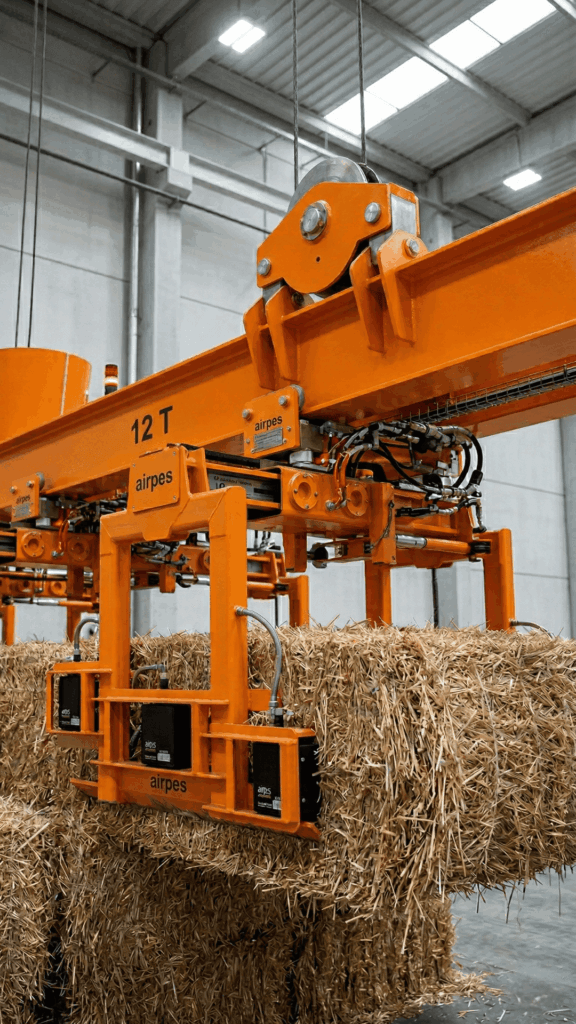
Our lifting beam for straw bales is a custom-engineered solution designed to grip, lift and transport bales safely within biomass energy facilities. As part of modern biomass fuel handling systems, this equipment streamlines the transfer of material from the receiving or storage area to the furnace feeding point. Thanks to its reinforced structural design and gripping system adapted to the bale geometry, it performs as a reliable bale handling system for continuous-duty operations, reducing manual handling and improving fuel flow efficiency throughout the plant.
Benefits
This solution combines structural strength, precise load handling and full adaptation to the customer’s process requirements. Integrated into wider biomass handling equipment installations, the lifting beam enables stable bale lifting, reduces risks during handling and ensures efficient interaction with overhead cranes, transfer lines and feeding stations. Its application-specific design for biomass bale handling and straw bale handling also helps automate repetitive operations, shorten cycle times and support a safer, cleaner and more productive plant environment.
Sectors
This equipment is especially suitable for biomass power plants, waste-to-energy facilities, thermal valorization plants and industrial environments where straw bales or other compacted biomass materials must be lifted and transferred before combustion or processing. It is also an ideal solution for engineering firms, EPC contractors and industrial operators looking for custom lifting and transfer systems for furnace and incinerator feeding processes.
Enhance your lifting operations with us
If you need a dedicated solution for bale handling in your process, we can help you develop a lifting beam tailored to your installation, overhead crane and load characteristics.
Contact our team to discuss your project and we will design a custom proposal to improve safety, operating continuity and the performance of your biomass handling process.
FAQS
How Do Biomass Systems Work?
Biomass systems convert organic materials such as straw, wood residues or other agricultural by-products into usable thermal or electrical energy. In many industrial facilities, the process starts with fuel reception, storage and preparation, followed by controlled transfer to the combustion or incineration area. This is where biomass fuel handling systems become critical. They ensure that bales or bulk materials move safely and consistently from one stage to the next. When straw is supplied in compacted format, specialized biomass handling equipment such as cranes, transfer devices and a bale handling system are required to maintain stable fuel flow, reduce manual intervention and support continuous energy production.
Why Is Bale Handling Important in Biomass Energy Plants?
In biomass plants using compacted agricultural fuel, bale handling is not a secondary operation but a core part of plant performance. Poor bale transfer can create bottlenecks, cause irregular furnace feeding and increase downtime. A dedicated bale handling system improves how material is gripped, lifted and positioned before entering the combustion line. For facilities processing straw, this is especially relevant because straw bale handling must be both safe and repeatable under demanding operating conditions. Well-designed biomass bale handling solutions help protect the fuel format, reduce unnecessary material loss and support more reliable operation across the entire energy generation process.
What Are the Main Challenges of Handling Straw Bales in Biomass Facilities?
Straw bales are not handled in the same way as pallets, containers or loose bulk solids. Their dimensions, compression level, density variation and surface behavior can change from batch to batch, which makes lifting and transfer more complex. In addition, biomass plants often require frequent, repetitive movement under continuous-duty conditions. This means that straw bale handling equipment must combine structural strength, secure gripping and process compatibility. A custom bale handling system integrated into broader biomass fuel handling systems can help overcome these issues by reducing instability during lifting, improving positioning accuracy and enabling smoother transfer from storage zones to the furnace feeding point.
When Should a Plant Choose a Custom Lifting Beam Instead of Standard Handling Equipment?
A custom lifting beam is the right choice when standard handling equipment cannot guarantee stable gripping, safe lifting geometry or proper integration with the plant layout. In biomass applications, every installation has its own crane configuration, bale format, throughput target and feeding arrangement. For that reason, off-the-shelf systems are not always sufficient. A purpose-built beam designed for biomass bale handling can match the real dimensions and operating conditions of the plant while working as part of a wider biomass handling equipment strategy. This approach improves control during lifting, supports repeatable cycles and helps adapt the bale handling system to the exact fuel handling process.
What Should Be Considered When Designing a Bale Handling System for Continuous Operation?
A bale handling system for continuous operation must be designed around more than lifting capacity alone. Engineers should consider bale dimensions, weight variability, gripping points, crane travel, cycle frequency, environmental conditions and the interface with downstream feeding equipment. In biomass facilities, the system also needs to support consistent flow so that combustion is not disrupted by handling inefficiencies. This is why biomass bale handling solutions are often tailored to the customer’s actual process rather than selected from standard catalogs. A robust design improves durability, reduces unplanned maintenance and ensures that biomass fuel handling systems can operate with the reliability required for industrial energy generation.
Related Products
-

TRACTION LOAD CELLS CT
The CT model of this traction load cells have been specially designed to work with traction with element detecting shear…TRACTION LOAD CELLS CTSeptember 22, 2020 -
MECHANICAL LOAD LIMITER ALM/M-100
The mechanical load limiter model ALM/M-100 has been designed to control the overload in elevation devices. Features of the ALM/M-100…MECHANICAL LOAD LIMITER ALM/M-100September 22, 2020 -
ALE-90 ELECTRONIC LOAD LIMITER
The economic electronic load limiter ALE-90 from Airpes has been designed to control the overload and slack cable of elevation…ALE-90 ELECTRONIC LOAD LIMITERSeptember 22, 2020 -
LOAD CELL CONVERTER ACO-200
The Load Cell Converter ACO-200 is a load cell to CANopen converter. Reads the analog signal of the load cell,…LOAD CELL CONVERTER ACO-200September 22, 2020